active
NSF ERI
Mechanics of granular media
Particle-resolved and multifidelity modeling of granular assemblies whose particles deform, break and rearrange under load.
Fracture & failure
Almost every model of a magnetic soft composite assumes the bond between a magnetized particle and the surrounding elastomer holds. Under a single load that is a reasonable simplification. Under a field cycled thousands of times it is likely the first assumption to give way, and that is what this project is built to test.
The question. A stiff particle in a soft matrix concentrates strain at its boundary. Each actuation cycle works that boundary a little. If debonding starts somewhere, it redistributes load to neighboring particles and changes both the mechanical stiffness and the magnetic torque the composite can transmit. The working hypothesis is that degradation of this kind is not a slow uniform fade: that it is a mechanism, and that it has a location. What has to be established is which interface property, particle arrangement and loading history decide when it starts and how fast it spreads.
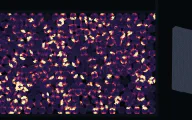
The figure above is a cohesive-zone simulation of that mechanism in its simplest form: stiff inclusions in a compliant matrix, with separations opening at the particle boundaries first (a), and only afterwards linking into a crack that crosses the specimen (b).
How the project approaches it. The mesoscale is where this has to be settled, so the model resolves individual particles and gives the interface its own constitutive description, a cohesive law with a finite strength and a finite energy, rather than treating it as either perfectly bonded or perfectly free. The step after that is to run those calculations across many arrangements and histories and identify how an effective damage variable evolves, which is what a continuum-scale model of a component actually needs.
That ordering is the point. A model that begins at a bulk crack has skipped the interface stage entirely; if that stage is what decides where the crack goes, the lifetime it predicts is the wrong one.
Henry Anderson leads this work. It shares its interface machinery with interface fracture in particle composites and its material description with hMSM design, which asks of the same composite how long it lasts rather than how well it moves.
Particle-resolved and multifidelity modeling of granular assemblies whose particles deform, break and rearrange under load.
Choosing where to put material and where to put magnetization, at the same time, so a soft structure moves the way a design problem asks it to.
Effective properties for a composite have to come from somewhere. This project derives them from resolved micro-scale fracture simulations, after first settling which description of the interface to trust.
A pull-off force is one number describing at least four different mechanisms. Separating them is what lets a measurement support a design rule that transfers, instead of one fitted curve.
Well-posedness, kinetic relations and convergence rates for models of dynamic fracture, and the crack behavior they predict around voids, inclusions and interfaces.
Parallel and asynchronous solvers, load balancing and distributed data structures for large mechanics and transport problems.
Peridynamics-based discrete element method for granular media with deformable, complex-shaped particles.

Joint material and topology optimization for field-responsive soft materials, extended from FEniTop and built on FEniCSx.

C++ library for finite-difference and meshfree discretizations of nonlocal deformation and fracture models.