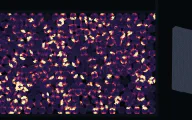
EstablishedMathematical analysis and convergent discretization of nonlinear fracture models, then PeriDEM, where deformable particles contact, fracture and fragment. That foundation now supports multiscale modeling of failure in heterogeneous materials.
Open nowWhen does particle-scale detail change the answer, and when will a coarser model do just as well? The NSF ERI project turns that question into adaptive multifidelity methods that concentrate resolution where fracture and failure demand it. In parallel, connecting microstructure and interfaces to effective elastic and fracture behavior in ceramic composites.
In a particle-reinforced composite a crack has options. It can run through the
matrix, deflect or arrest at an interface, debond an inclusion, or split it,
and each event redistributes stress and energy, changing which mechanism acts
next.
The scientific question. How do matrix cracking, interface debonding,
particle fracture and contact interactions compete to control strength,
toughness, localization and residual load capacity in heterogeneous materials?
Granular materials are the complementary limit: breakage there also creates
fragments, contacts and load paths, without a bonded matrix to carry them. The
same descriptors of load redistribution and energy partition ought to transfer
between the two, and testing whether they do is the point.
Underneath both sits a longer line of work on whether the models can be
trusted at all. A simulation of a crack is only evidence if the formulation is
well posed, if the discretization converges, and if the result is the material’s
behavior rather than the mesh’s. Most of the published record in this thrust is
exactly that: well-posedness for nonlinear models of dynamic fracture, a
priori error estimates for finite-difference and finite-element
discretizations, convergence rates in Hölder and Sobolev settings, kinetic
relations recovered in the classical limit, and the solver engineering that
makes any of it run at scale. It is unglamorous and it is the foundation: see
mathematical foundations of fracture and
scalable solvers. The particle-scale
work above inherits its credibility from it.
PeriDEM and the NSF Engineering Research Initiation award on adaptive
multifidelity modeling of heterogeneous materials provide the computational
basis. The working hypothesis is that macroscopic failure is governed by the
competition among matrix, interface and particle fracture, and that descriptors
retaining that evolving redistribution predict failure better than an
accumulated scalar damage law.